The battery weighs 3.11g (w/ connector), dimension 1.1 x 0.5 x 0.22", connector JST.

Discharging


Charging

The kink is caused by switching from constant current (100mA) to constant voltage (4.2V) charging.
This TTL to USB serial converter cable had been in used for many years. It could no longer receive, but still could send. A loopback test between TXD and RXD got no response. A resistance measurement between RXD and any other pins showed open. I cracked open the USB connector to expose the circuit board and confirmed that there was no open in the wire. The circuit board is just a FTDI FT232R chip (3Mbaud, FS USB) and a few passives. The date code of the IC is 1344-C, which is 44th week of 2013, rev C. FT232R is not recommended for new designs by FTDI. The output signals have 100Ω in series; the input signals go straight into the IC. This version of board has 3.3V output.
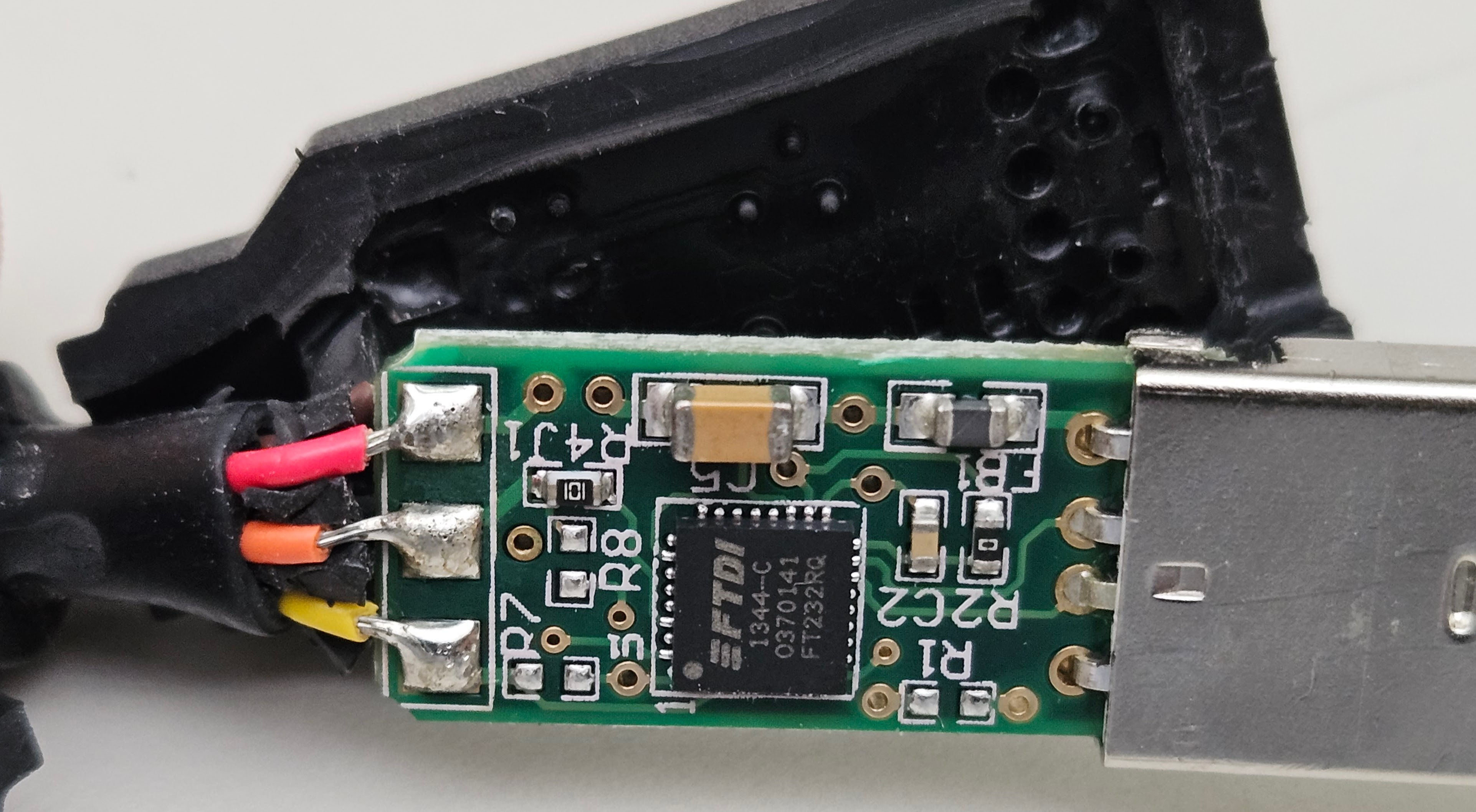
I checked the solder joint which appeared no different from the others. I probed directly at the IC pin and found the RX pin was still open. It could be an open bond wire or a metal trace on the IC. It's hard to image a failure of transistors could leave it complete open. It could be caused by an ESD event. The datasheet does not give any information on the ESD protection level; one app note says the FTDI IC's are tested to 2.5-3kV, not sure which (HBM, CDM, or MM). I suspect it is the HBM, which would make it Class 2, a little low for interface, but the IC is intended to work with other line drivers.

Once in a while, you find yourself staring at a printed circuit board with a shorted power rail. It could be any of the components, capacitors, diodes, ICs. Sometimes, you have a hunch which component might be bad and remove that component to see if the short goes away. But you might take off one component after another, still could not located the bad component.
One way to quickly identify the faulty component is to apply current to the shorted rail and look for the hot part. You may have to apply a few amps of current, but not too much current to damage the traces. Sometimes you can actually see a component starting to smoke; other times, you have to feel the heat. If you have a thermal imager, you can easily see the hot spot.
Here we'll look at Panasonic Ni-MH battery charger, rated as 0.3A for AA and 0.15A for AAA. It can accommodate 1-4 AA or AAA cells.


The AC to DC conversion uses SC1142D1 by Power Integrations. No datasheet is available, but an application schematic is found, which gives the idea how the circuit might work. A third transformer coil provides the feedback; no opto-coupler is used.

A slot in the PCB increases the creepage distance from the AC primary.
The charging control is based on a microcontroller EM78P418N by ELAN Microelectronics, a Taiwanese company. EM78xxx is called "a RISC-like single chip microcontroller" by the manufacturer. But its instruction set is akin to PIC or 8051. It has an internal oscillator of 4MHz.
Pulse charging method is used: power is applied on and off and open-circuit voltage is measured when the power is off.
